Before the Wristwatch, How Pocket Watches Set the Pace
See how pocket watches changed everyday timekeeping, turning a public clock check into a private gesture—and why the wristwatch made time visible.
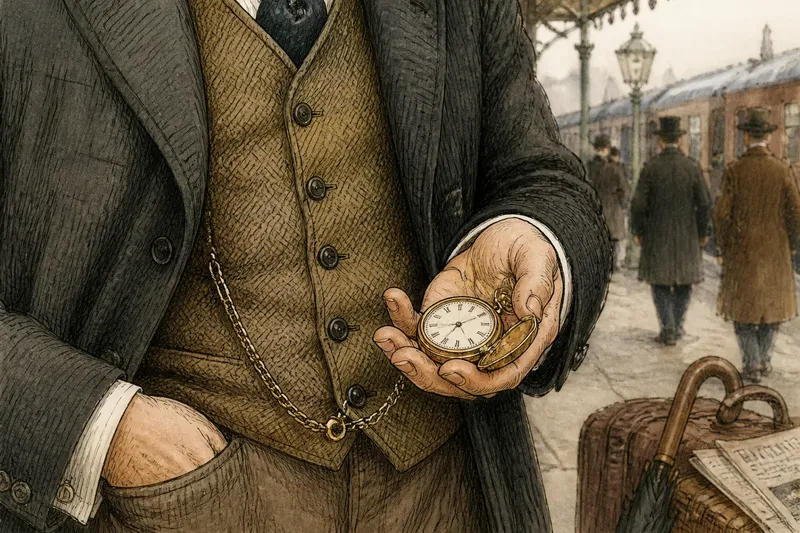
A train platform clock can be checked without breaking stride; a pocket watch asks for a small pause. Before the wristwatch, the pocket watch set the pace by making the hour personal but not constantly visible: its owner reached for it, opened it, read the dial, and put it away. That brief ritual shaped how people consulted time in the middle of ordinary activity.
The hour in your pocket
A pocket watch carried time close to the body, yet concealed it beneath clothing. Often worn in a vest or waistcoat pocket and linked by a chain, it was accessible without being on display. The chain could secure the watch and keep it from slipping away; it could also signal that the object was meant to be carried and handled.
Checking the hour took a sequence of movements: locate the pocket, draw out the watch, open its cover if it had one, and angle the face toward the light. A hunter-case watch, with a hinged cover over its dial, added another action. An open-face watch skipped that step, though it still had to be taken out and held where its hands could be read.
These small differences mattered during a day full of tasks. A person walking, working with both hands, or carrying something could not glance at the time as easily as someone sitting still. The watch did not dictate every action, but consulting it required enough attention to feel like a deliberate interruption.
A private time check
The pocket watch made a clock portable without making the clock face public. To learn the time, its owner had to handle the object. That could turn a check into a quiet, personal gesture: a glance at the dial, perhaps shielded by a hand or performed below the level of a conversation.
This was not absolute privacy. Someone nearby might see the watch or hear a cover click. Still, the face was usually pointed toward its owner rather than presented to everyone in view. The difference from a large clock on a wall was practical as well as social: the wall clock could be read at a distance, while the pocket watch belonged to the person carrying it.
That distinction encouraged a rhythm of checking rather than continuous viewing. A person might consult the watch before setting out, during a pause, or after noticing that a meeting or departure was approaching. The act could be planned around a natural break instead of folded into every movement.
Chains, pockets, and habits
A chain was useful, but its arrangement depended on the clothing and the wearer. A watch might sit in a waistcoat pocket with the chain attached to a buttonhole, or be carried in a trouser pocket. The chain’s visible arc could identify the watch’s location and reduce the chance of dropping it while drawing it out.
The pocket also influenced posture. Reaching into a vest pocket often meant bringing an elbow close to the body and briefly turning attention inward. In a formal setting, that could look measured; during a hurried errand, it could feel cumbersome. The same watch suited both moments, but the wearer adjusted the ritual to the setting.
Say you are waiting for a carriage and expect it soon. You feel the watch through your vest, take it out during a lull, read the hands, and return it before the carriage arrives. The visible result is modest: you know whether you have time to keep waiting, but your attention was away from the scene only for a short interval. A wristwatch would make that same check possible with less handling.
What changed with the wristwatch?
Moving a timepiece from pocket to wrist changed the route between a question and an answer. Instead of reaching through clothing, a wearer could turn the wrist and bring the dial into view. The watch remained personal, but it became easier to consult while standing, walking, or keeping one hand occupied.
The shift also made time more visible to other people. A raised wrist can be noticed across a table or during a conversation, even when the wearer intends only a quick glance. The pocket watch’s handling had often hidden the check inside a reach; the wristwatch brought the gesture closer to the surface.
Neither arrangement made people more or less punctual by itself. Each made certain checks easier and others more conspicuous. A pocket watch suited a slower, deliberate consultation; a wristwatch supported frequent glances and could be read without taking the object out of clothing.
Which watch suits which moment?
For a reader comparing the two, the useful question is not which design is universally better, but how the time is meant to be consulted. A pocket watch asks for a free hand and a pause. A wristwatch asks only for a turn of the wrist, though that movement can be visible to others.
- Choose a pocket watch for a deliberate check: it keeps the dial covered until you bring it out.
- Choose a wristwatch for quick glances: it is easier to consult while moving or carrying something.
- Think about clothing: a pocket watch needs a secure, suitable pocket and a comfortable way to attach its chain.
- Consider the setting: a visible wrist glance may interrupt a conversation more than a discreet reach into a pocket.
- Notice your routine: if you check the hour only at natural pauses, the pocket-watch ritual may feel unhurried; if you need frequent checks, access at the wrist may be more convenient.
For a vintage watch, its own instructions and the maker’s guidance matter for care and handling. The physical comparison is straightforward, but the needs of an old mechanism are not the same as those of a modern everyday watch.
Why did pocket watches use chains?
A chain connected the watch to clothing, helping keep it close and making it easier to recover if it slipped from the hand. Its placement also reflected the pocket and garment the owner used. Some chains were plainly practical; others added a decorative detail to formal dress.
Could a pocket watch be checked while walking?
Yes, but it took more coordination than a wrist glance. The wearer had to reach into a pocket and hold the watch where the dial could be read, so stopping or slowing down made the action easier.
Was a wristwatch always faster to read?
It generally required fewer handling motions because the dial was already on the wrist. A pocket watch could still be read quickly once in hand, but reaching and opening a cover, when present, added steps.
Did pocket watches make time private?
They made the act of checking more self-contained, not entirely hidden. The watch face usually pointed toward its owner, while a person nearby could still notice the movement or the watch itself.
The gesture remains
Even now, a watch is not only a device that displays the hour; its location shapes how a person asks for it. A pocket watch turned timekeeping into a short, private handling ritual, while the wristwatch made the same information easier to summon in passing. To understand how pocket watches set the pace, notice the reach, the pause, and the return to the pocket: those movements were part of telling time, too. What is not worth the effort is treating one gesture as proof that an entire period moved at a single speed. The useful distinction is narrower: a pocket watch asked its owner to make a moment for the clock, while a wristwatch brought the clock into the moment.