The Queue Is Not Always First Come, First Served
Queue etiquette depends on more than arrival time. Learn how to read the local order, clarify who is next, and avoid cutting in by mistake.
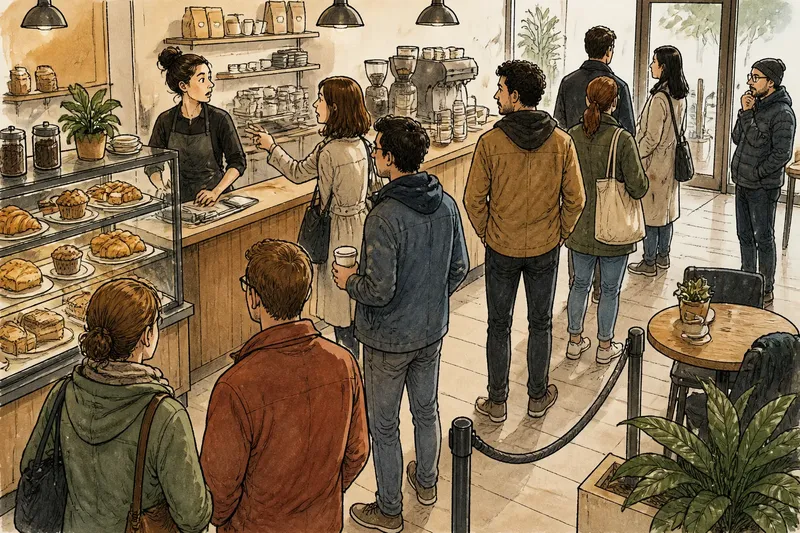
You step toward a café counter just as someone beside you finishes ordering. A person near the pastry case says, “I was after her,” and the barista turns to them. The queue seemed obvious until it did not. Queue etiquette is not always first come, first served: people also rely on signals about where a line begins, which service it belongs to, and what counts as a turn.
That does not mean every arrangement is arbitrary. Most queues have a recognizable local rule, even if nobody has written it down. A useful habit is to spend a moment reading the scene before joining, then make your place visible without claiming more certainty than you have.
Read the local order
Start by looking for the service point and the people waiting to use it. A single-file line usually makes order easy to see. A loose cluster may work differently: people can be waiting for separate staff members, separate counters, or a call to approach. At a deli, for instance, a number ticket may decide who is next even when people are standing in several places.
Look for objects that organize the queue. A rope, floor markings, a sign, a ticket dispenser, or a screen can mark the intended route. The start of a line may sit away from the counter, especially in a busy lobby or at a temporary service desk. Joining beside the person closest to the cashier can accidentally put you in the middle rather than at the end.
Then watch what happens when service begins. Does the next person step forward from a single line? Does a worker call a number? Do people move toward whichever clerk becomes free? The first few interactions often reveal more than the shape of the crowd. Follow the rule people are actually using, unless a posted instruction says otherwise.
Notice the hidden signals
Informal queues use small signals to keep track of turns. Someone may hold a place while a companion asks a question, leave a bag beside a spot, or step aside briefly to check a form. These signals can be easy to miss, and they do not all carry the same meaning in every setting. A bag near a chair might mark a place in one waiting room and simply be unattended property in another.
People also distinguish between waiting for a particular service and waiting for any available worker. In a bank, customers might form one line that feeds several tellers. At a food truck, separate lines may form for different pickup windows. In a small shop, a customer asking a quick question may be served without joining the same line as someone placing a complex order. The apparent exception can reflect a different task, not a challenge to the queue.
Keep your interpretation modest. A person who steps away might be returning to a marked place, or they might have left the line. Someone who approaches a counter could have been called forward. If you cannot tell, a quiet question is better than an accusation.
Join without guessing
When the order is unclear, pause near the apparent waiting area rather than moving directly to the service point. Look for a sign or ask the person at the end, “Is this the line for the counter?” If several people are gathered, ask, “Who’s next?” in a tone that lets someone correct you. These short questions make your intention clear and give the group a chance to explain its convention.
Once you have joined, make your place legible. Stand behind the last person in a single-file line, leaving enough room for people to pass where the setting allows it. In an open cluster, stay with the group and keep track of who arrived before you. Avoid drifting toward the counter simply because a gap opens; a gap may be part of the waiting area, not an invitation.
If you need to step away, say so to the person behind you: “I’m going to check the menu; could you let me know if the line moves?” They may not be able to hold your place, but asking is clearer than leaving without a word. When you return, check whether the order has changed rather than assuming the spot is still yours.
Handle uncertain turns?
What if two people claim to be next?
Let the person serving decide if they have seen the order, or ask the waiting group calmly who was there first. If the disagreement remains unclear, stepping back and letting the other person go can be simpler than turning a brief wait into a dispute.
Can someone with a quick request go ahead?
Some groups allow a short question or a single-item purchase to fit between longer transactions, while others keep one strict line. Ask the people waiting before approaching, and accept a no without treating it as a personal slight.
What if a person leaves and returns?
People sometimes step away to collect a document, answer a call, or check an order, but a place is not always held automatically. If they told nearby people they were coming back, the group may recognize that; if not, ask the person serving or the people waiting instead of deciding on their behalf.
Should I correct someone who cuts in?
First consider whether they may be following a different arrangement, such as a ticket system or a separate service queue. If the order is clear and the interruption matters, a neutral “The line starts back there” is more useful than an insult or a public accusation.
Practice over one week
You can make this a small routine rather than trying to memorize a rule for every shop. The point is to notice the queue’s organizing signal, then use a brief question when the signal is missing.
- On your next café visit: check whether customers form one line, approach separate registers, or wait for names to be called. Join at the marked start or ask where the line begins.
- At a service counter: look for ticket numbers, signs, or a single line feeding several staff members. Follow the instruction that governs the service, not just the nearest open counter.
- During a busy shop visit: notice whether people wait in a line or gather near a clerk. If the order is hard to read, ask who is next before stepping forward.
- When you need to leave your place: tell the person behind you what you are doing and ask whether they can keep track of the line. If they cannot, recheck the order when you return.
- At the end of the week: recall which visible signals were useful: a rope, a ticket, a sign, or a spoken agreement. Use those signals first the next time you enter a similar setting.
Say you enter a pharmacy where several people stand near two counters and no one is clearly at the end of a line. You ask, “Are these separate queues, or is there one order for both counters?” A customer points to a number dispenser; you take a ticket and wait for it to appear on the screen. The expected result is straightforward: you know which signal controls your turn, and the people already waiting do not have to guess what you intend.
What not to overdo
It is not worth policing every small pause, checking the arrival order of the whole room, or treating a harmless misunderstanding as deliberate line-cutting. A queue is a shared arrangement, not a contest in strictness. Pay attention to clear signs, ask a concise question when needed, and leave room for the people around you to clarify how this particular line works.
For queue etiquette, the most reliable cue is often the one everyone can see or hear: a numbered ticket, a marked entrance, or a worker calling the next person. If none appears, a calm “Who’s next?” can establish the order without turning an ordinary wait into a confrontation.