A Pocket Notebook for Catching Questions on the Commute
A pocket notebook for questions on the commute helps you preserve what sparked your curiosity and choose a useful next reading cue without starting a research project.
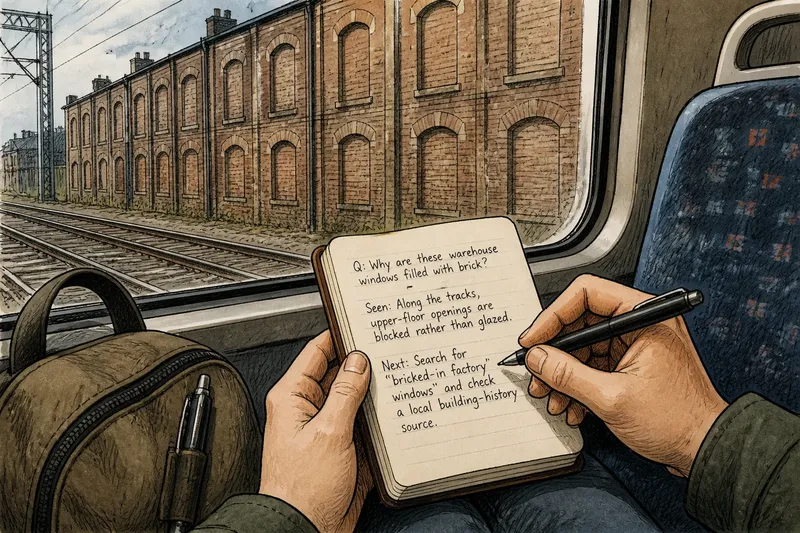
The train passes a row of old brick warehouses, and you wonder why their windows are bricked over. A pocket notebook for questions on the commute can hold more than the question itself: it can preserve what prompted it and leave you a clear cue for what to read later. The aim is not to investigate while you travel. It is to catch a thought before the next stop, then make it easy to pick up again.
Choose a small notebook
Pick a notebook that fits the pocket or bag you already reach into during a trip. A narrow memo book or small stitched notebook is enough. You do not need a special paper, an elaborate index, or a matching pen. A simple ballpoint that starts reliably is often more useful than a favorite pen kept at home.
Consider how you travel. If you are usually standing on a crowded bus, a stiff cover and a pen clipped to it may be easier to handle than a floppy pad. If you have a seat and a little room, almost any notebook that opens flat will do. Avoid a format that needs a table, a phone app, or a long pause to use.
Choose one place for these notes rather than scattering them across receipts, message drafts, and loose paper. If the notebook also contains other jottings, reserve a few pages near the back for commute questions or mark the first page with a simple heading. A system that is obvious at a glance is easier to keep using.
Catch the question
Write the question in the words that came to mind. Do not revise it into a polished research question on the moving vehicle. “Why do some buses kneel at the curb?” is more useful than a vague entry such as “bus design,” because it tells your later self what caught your attention.
Keep the wording open if you are not sure what you mean. A question can be a fragment: “Why the blue stripe on this map?” or “Who decides which street gets renamed?” You can clarify it later. The notebook’s first job is to keep the curiosity recognizable, not to make it sound formal.
If the question is already on your mind, jot it down before it slips away. If you are still noticing the scene, capture a few words and return to looking. Do not let note-taking pull your eyes from the road, platform edge, stairs, or other surroundings that need your attention. Wait until you are safely seated or stopped before writing, and use a quick mental phrase to hold the thought in the meantime.
Keep the context
A question without its setting can become oddly hard to understand later. Add a short context cue: the object, place, sound, or conversation that prompted it. “Why are bus seats patterned?” is a question; “On the older bus, the seats have small blue and gray shapes” gives you a way to recognize the original observation.
Context is not a travel diary. You usually need only a few concrete words: “station map,” “rainwater channel,” “ticket machine,” or “announcement before the bridge.” If a particular detail matters, record it precisely enough to distinguish it from another instance. A color, a label, or the wording on a sign may be enough.
Leave out details that do not help you return to the question. There is little value in recording every stop, the weather, or what you were wearing unless one of those things explains the observation. The note should take a moment, not turn the ride into an account of the ride.
Add a reading cue
End the entry with one next reading cue: a source, a search phrase, or a person or place to ask. This is a handoff to your future self, not a promise to complete a project. “Look for city bus kneeling mechanism” is a practical cue. “Research buses” is too broad to point you anywhere.
When you know a likely source, name it plainly: a library catalog, a transit agency’s vehicle information page, a dictionary, a museum label, or a map legend. If you do not know the right source yet, write a phrase that preserves the useful terms. For the bricked-up warehouse windows, that might be “brick-filled industrial windows purpose.” The phrase can be imperfect; it just needs to get you back to the question.
Keep the cue to one line. Adding a list of books, websites, and possible experts can make a passing curiosity feel like an assignment. If the subject seems important enough for more than one lead, choose the most promising starting point and leave the rest for later.
Use one compact entry
Give each question a small, repeatable shape: question, context, cue. Labels can make the parts easy to spot, but short lines work just as well. For example:
- Q: Why are these warehouse windows filled with brick?
- Seen: Along the tracks, upper-floor openings are blocked rather than glazed.
- Next: Search for “bricked-in factory windows” and check a local building-history source.
The entry preserves a question, the scene that led to it, and one route back into the subject. It does not assume that the explanation is obvious or settle on a theory before you have looked. When a detail is uncertain, mark it as uncertain: “I think the openings are bricked, not painted.” That small distinction can stop a later search from treating a hurried impression as a fact.
Say you notice a row of small metal plates beside doors on your usual train. You write, “What are the plates for?” Then you add, “Near carriage doors, each has a short number,” and finish with, “Check the rail operator’s carriage diagram.” At home, the context helps you search the right feature rather than “metal plates on trains” in general. The expected result is a more focused first look, not an obligation to reach a definitive answer.
Stay attentive on the ride
Use the notebook when the moment permits. On a crowded platform or while crossing a street, keep it put away. If writing would make you miss an announcement or lose awareness of your surroundings, hold the question in mind until you are settled. A useful note is not worth compromising ordinary travel awareness.
On a short ride, capture only the question and a context word, then add the cue later. On a longer trip, you may have room for all three lines. Either way, resist searching on your phone just because the question has been written down. The notebook is there to preserve the thread; reading can wait for a place and time when you can pay attention.
What is not worth the effort is designing a color code for subjects, assigning every question a priority, or copying each entry into a second system. Those routines can turn a lightweight habit into maintenance. Add a mark or category only if you repeatedly need it to find something.
When should you return to a note?
Should every question be researched?
No. The notebook can hold questions that are simply pleasant to notice, and some may stop feeling interesting later. Read further when the curiosity still matters to you, not because every line needs to be completed.
What if the question is vague?
Keep the original wording and add the observed detail that prompted it. A later reader of your own notes can use that clue to sharpen the question without losing the first spark.
What if you cannot name a source?
Write the distinctive words you would try in a search, along with a kind of source that might help, such as a city page or a library reference book. You can choose a specific source when you are no longer in transit.
How often should you review the pages?
Pick a natural pause, such as the end of the week or a quiet moment at home, and glance through the recent entries. Keep the questions that still invite attention, add a better cue if one comes to mind, and let the rest remain notes rather than unfinished tasks.
Return without overbuilding
When you do revisit an entry, start with its cue and read only enough to understand the next useful piece. If a source uses a term you do not know, add that term as a new cue. If the first lead is irrelevant, cross it out and write a better one; the point is to make the next attempt easier, not to preserve a perfect record.
Some questions will lead to a quick answer. Others will stay open because the clue was incomplete or the subject has several explanations. You can note what you learned in a brief phrase if it will help later, but do not turn every commute note into a dossier. The small record has done its job if it preserves the question and points you toward a sensible next reading.
Keep the pocket notebook where it can be reached without rummaging, and leave a little blank space after each entry. That space gives you room to add a source or a useful correction later. A pocket notebook for questions on the commute works best as a small bridge between noticing something and deciding, at your own pace, whether it deserves more attention.